A Closer Look at Conducting a factory inspection in China
An effective factory inspection starts with the decision it needs to support. A focused brief, planned evidence route, and clear follow-up make the visit more useful and its limits easier to understand.
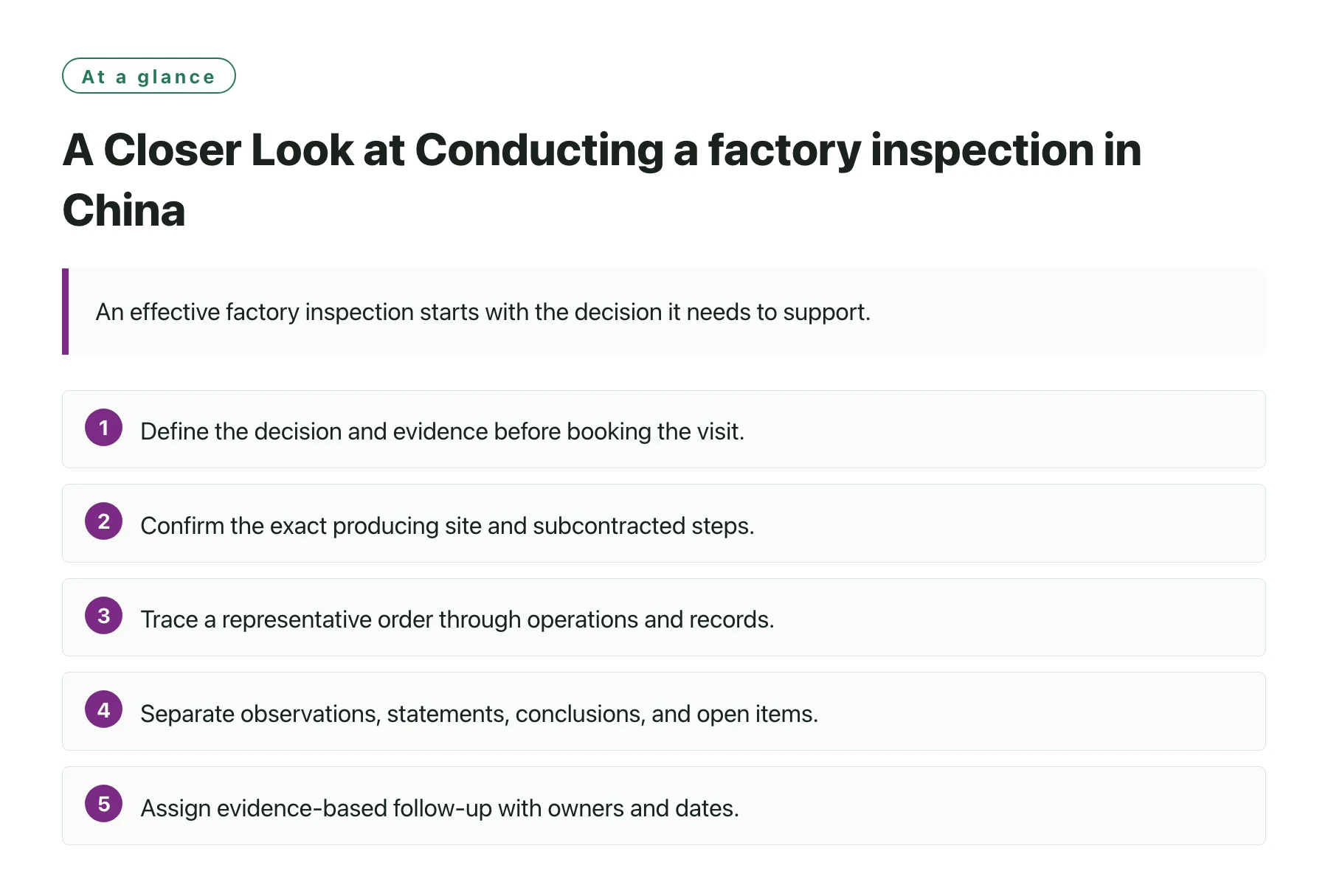
Key takeawaysDefine the decision and evidence before booking the visit. · Confirm the exact producing site and subcontracted steps. · Trace a representative order through operations and records. · Separate observations, statements, conclusions, and open items. · Assign evidence-based follow-up with owners and dates.
A factory tour is only one part of supplier review. The buyer needs a repeatable method for checking records, comparing claims, and closing findings.
1. Build the inspection brief around a decision
Before scheduling a visit, define what decision it should support: whether to shortlist a facility, whether a process can meet a requirement, whether corrective actions are effective, or whether an order is ready to start. These are distinct objectives. List the questions, evidence, and acceptance conditions that would change the decision, then set the visit scope accordingly.
Provide the inspector with product family, purchase stage, key risks, approved requirements, supplier identity, and a list of open questions. Rank the topics so limited time is spent on important controls. Keep questions neutral and evidence focused; the purpose is to understand the facility’s process rather than confirm a preferred conclusion.
2. Align facility identity and visit logistics
Confirm the exact address and legal or operating entity for each site on the itinerary. Ask whether the named facility produces the product, performs one process, stores finished goods, or hosts only administrative staff. Clarify any subcontracted steps and decide whether additional locations need separate review.
Agree access, local contact, transport, interpreter, protective equipment, photography rules, and any restricted areas. Ask whether relevant production will be running and what records can be reviewed. Prepare a contingency if a line is idle or a key manager is unavailable; record the resulting limitation rather than silently changing the scope.
3. Verify the partner and organize evidence
The U.S. Department of Commerce recommends due diligence when evaluating foreign business partners. Verify business identity, key contacts, payment instructions, and material claims through suitable independent sources, then retain the date and evidence for each check. A site visit contributes observations but does not replace all identity or commercial checks. [1]
Create a document request list with owner and due date: process flow, quality procedures, recent inspection records, equipment list, calibration records where relevant, corrective actions, and an example production traveler. Ask for redacted samples if confidentiality limits access. Review documents before travel and reserve on-site time for inconsistencies or gaps.
4. Use a repeatable route through the facility
Plan a route from incoming materials through production, inspection, packing, and dispatch. At each stage ask what identifies the item, what instruction controls the work, who checks it, what record is created, and where nonconforming product goes. Observe a normal work sequence when possible rather than a staged demonstration only.
Follow one representative order or lot through several records and locations. Check whether product identity and revision remain consistent as work moves. When a claimed control cannot be observed, ask for the best available record and describe the evidence limit in the report. Do not infer an entire system from one clean workstation or one sample file.
5. Ask questions that uncover operating practice
Use open questions such as “show how a changed drawing reaches the line” or “what happens when a check fails?” Follow up with a recent example. Compare answers from managers, operators, quality staff, and warehouse personnel. Differences may reveal training or communication gaps that a written procedure alone will not show.
Ask who can stop production, release held material, authorize rework, and communicate a deviation to the buyer. Request a sample exception record and trace its closure. Record statements as statements, observations as observations, and conclusions as conclusions; that distinction makes findings fairer and easier to act on.
6. Examine capacity and supply continuity
Review which operations are performed at the site, relevant machinery, staffing, shifts, current load, bottlenecks, maintenance, and peak-period plans. Compare capacity claims with production records for comparable work. Note whether figures describe theoretical machine rate, available hours, or output after quality checks and changeovers.
Discuss dependence on single-source components, utilities, outside processors, and seasonal labor where they could affect the order. Ask what alternatives exist and how changes are approved. A factory visit cannot forecast every disruption, but it can show whether the supplier has identified dependencies and a route for escalation.
7. Capture findings with evidence and context
Use a structured note for each finding: topic, requirement, what was observed, evidence reference, interview or document source, risk, and requested follow-up. Include date, room or line, sample size, record period, and any conditions that affect interpretation. Use photographs only with permission and connect each image to a finding.
Prioritize issues by consequence and likelihood, but avoid an overall pass label that obscures serious open questions. Separate a confirmed nonconformity from an improvement suggestion or an unverified claim. Give the supplier an opportunity to correct factual errors while retaining the original observation and documenting the resolution.
8. Handle confidentiality, independence, and safety
Agree how buyer drawings, customer identities, and supplier records may be stored and shared. Use appropriate confidentiality terms and limit access to the people who need the material. Establish photo handling, retention, and secure transfer before the visit, especially when more than one reviewer is involved.
Confirm the inspection provider’s experience and any relationships with the facility. Name who may approve changes to scope and who makes the supplier decision. Follow site safety instructions, stop work if conditions are unsafe, and never pressure personnel to bypass safeguards for demonstration purposes.
9. Close with a practical action list
At the closing meeting, confirm observations, missing evidence, immediate containment needs, and owners for follow-up. Do not negotiate acceptance of a defect unless the buyer’s authorized decision maker is present. Agree when the report will arrive and what evidence should be attached.
Turn each open item into an action, responsible person, due date, and closure test. Decide whether the next step is document review, a second visit, a sample test, or a production control. A good report states what the visit did not establish so stakeholders do not treat a snapshot as a permanent guarantee.
10. Connect findings to supplier selection
Use facility observations with quotation terms, sample evidence, references, and order controls. Identify which risks can be reduced by contract terms, incoming checks, pilot production, or approved alternatives. Keep selection and product acceptance authority assigned to named buyer owners.
Teams arranging a factory inspection in China can define a focused visit brief and a follow-up register before a supplier is chosen. Revisit the inspection plan when the production site, subcontractors, product revision, or intended application changes materially.
Sources
Frequently asked questions
How should I prepare for a factory inspection in China?
Set a decision objective, confirm the facility and access, send a focused evidence request, and plan a repeatable route through the relevant process.
Can one factory inspection approve a supplier permanently?
No. It records evidence at a point in time and should be combined with order-specific controls and follow-up as the operation changes.
What records are useful during a factory visit?
Review records linked to the product, such as process instructions, production travelers, inspection results, calibration where relevant, and corrective actions.
What should happen after the inspection?
Prioritize findings, assign owners and due dates, define closure evidence, and decide whether another check is needed before award or production.