The Documents a Fragrance Factory Should Hand You
Documents are how a manufacturing promise becomes checkable. A quotation tells you what a factory intends to do; a specification, a batch record, a safety data sheet and a certificate scope tell you what it can prove it did. Most buyers collect the easy papers and skip the two that matter most — the batch record and the written production scope — which are also the two that reveal whether the process is documented or improvised.
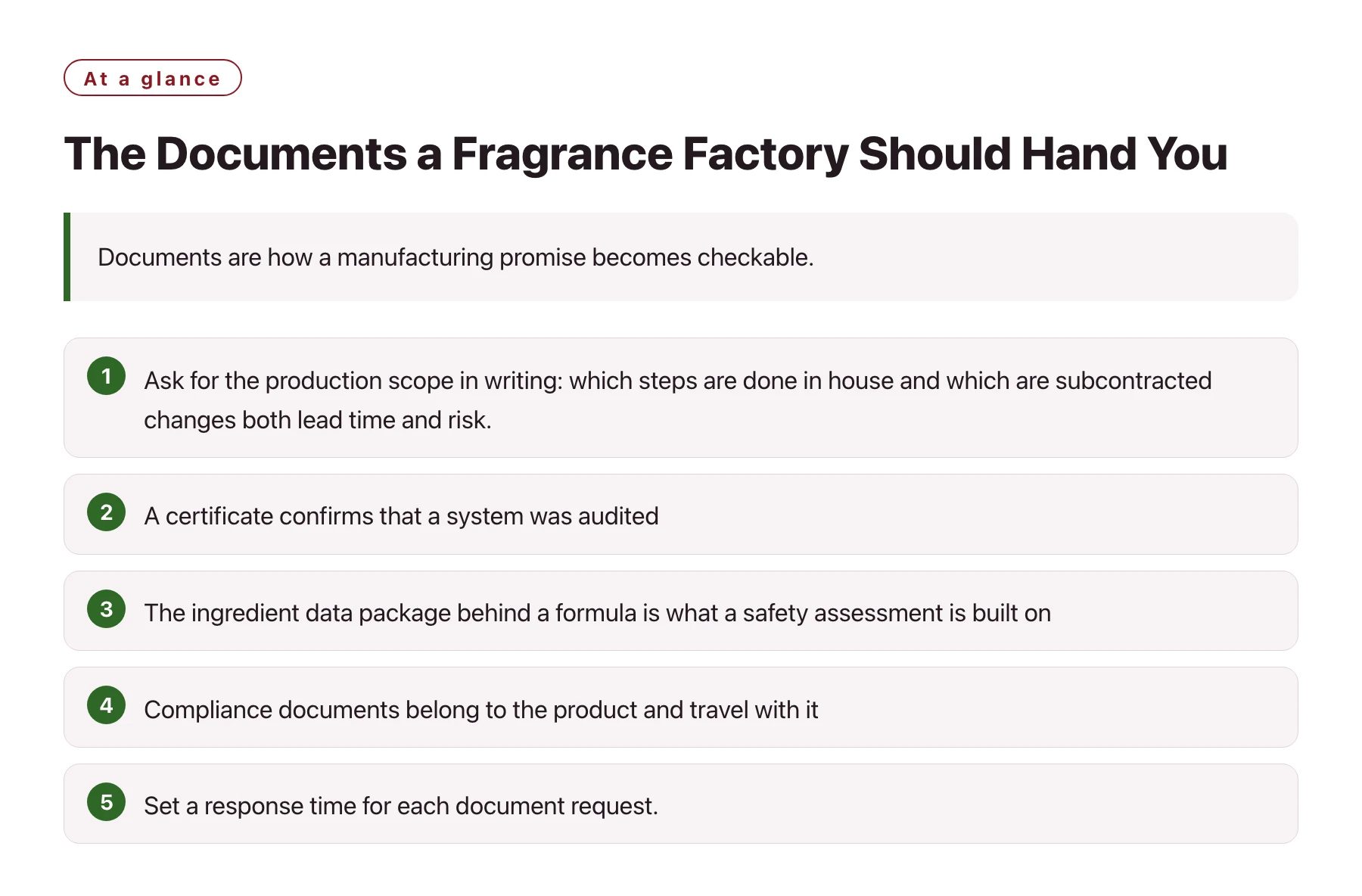
Key takeawaysAsk for the production scope in writing: which steps are done in house and which are subcontracted changes both lead time and risk. · A certificate confirms that a system was audited; only a batch record shows what happened on a specific run. · The ingredient data package behind a formula is what a safety assessment is built on, so request it by name [1]. · Compliance documents belong to the product and travel with it, which is why the brand should hold copies rather than rely on the factory's archive. · Set a response time for each document request. Speed and specificity on paperwork predict how the production phase will run.
Every experienced buyer has a version of this story: the project is approved, the launch date is set, and then someone asks for the document that proves the fill weight or the material origin, and it does not exist in the form required.
The fix is unglamorous. Ask for the document list at the start, agree who produces each item and when, and treat the paperwork as part of the deliverable rather than an afterthought. Factories that export regularly already work this way, and asking for the list early makes that visible.
What follows is a working checklist, ordered by when each document should be requested rather than by how official it looks.
The order to ask for things
- Production scope: which steps — compounding, filling, decoration, assembly, testing — happen on site and which are bought in.
- Specification sheet: formula reference, concentration, fill weight and tolerance, components, batch coding and release criteria.
- Certificate list with numbers, issuing bodies and scope for each entry.
- Ingredient and material data package: safety data sheets and the composition detail a safety assessment needs [1].
- Restriction check: written confirmation of how the formula was checked against the applicable restriction list [2].
- Test plan: which tests are run, by whom, on which samples, and what a pass looks like [3].
- Batch record for the production run, from raw material intake to release.
- Retained reference sample, sealed and labelled, held by both parties.
What each document is actually for
| Document | Question it answers | Usually issued by | Common gap |
|---|---|---|---|
| Production scope | What is done in house and what is subcontracted | Manufacturer | Described verbally and never written down |
| Specification sheet | What the product is, precisely enough to repeat | Manufacturer, approved by brand | Missing tolerances and batch coding method |
| Certificates | Which management systems were audited, and over what scope | Certification body | Scope not checked against the work being bought |
| Ingredient data package | What is in the formula at a level a safety assessor can use [1] | Material suppliers, collated by the manufacturer | Arrives late, or incomplete for one material |
| Restriction check | Whether the formula respects the applicable limits [2] | Manufacturer's technical team | Done after selection rather than before |
| Test plan and reports | Whether the product meets the agreed criteria [3] | Third-party laboratory, commissioned by either side | Tests excluded from the quote and never commissioned |
| Batch record | What actually happened on this run | Manufacturer's production and QA | Offered as a summary rather than the record |
| Reference sample | What the approved product smells like and looks like | Both parties retain a copy | Only one copy exists, at the factory |
The fourth column is where projects quietly lose time. Almost every gap on this list is a document that everyone assumed someone else had asked for.
Certificates are a filter, not evidence
Certification matters, and a factory that holds a recognised cosmetics GMP standard is easier to work with than one that does not. What it does not do is tell you what happened on your batch. A certificate is issued against a system and a scope, and the scope is the part buyers skip.
So do two things. Verify the certificate with the issuing body rather than accepting a scan, and read the scope to see whether it covers the activities your product needs. Then put the certificate aside and ask for the batch record, because that is the document that answers the question you are actually asking.
The same discipline applies to regulatory paperwork in the destination market. In the EU, for example, ingredients can be subject to scientific assessment, and an opinion can affect what a formula may contain [4]. The document that proves a formula was designed around those limits is the restriction check, not the certificate.
The list also changes with the model. If the project is a formula the brand already owns, made on someone else's line, you are looking for an OEM partner for perfume brands and the paperwork concentrates on process control, tolerances and repeatability. If the manufacturer develops the direction, add the development records and the formula reference to the list, because those are the documents that determine what you can take elsewhere later.
Why the batch record request is the most revealing one
A factory with a working quality system can produce a batch record in minutes, because the record was written as the batch was made. A factory that reconstructs it after the fact will ask for time, send a summary, or offer a certificate instead.
When you read the record, look for the points where a decision was made: a raw material lot that differed from the previous one, a fill weight measurement outside the first reading, a deviation with a signature next to it. A record with no deviations at all over several runs is possible, but a record that shows how deviations are handled tells you more.
How to see the shape of a service scope
Before the audit, it helps to compare what a factory says publicly with what you are being quoted for. Learn more about the service scope on a manufacturer's own page and check whether the written list matches the services in your quotation; a mismatch is a question worth asking early rather than a reason to walk away.
Who should hold which document
Compliance documents belong to the product, not to the factory, and they need to survive a change of supplier. The brand should hold the specification, the approved artwork, the safety documentation and a copy of the batch record for every run. The manufacturer holds the master formula, the process documentation and the tooling records.
That division has a commercial consequence. If the brand holds everything except the formula, moving to another manufacturer means reformulating. If the brand holds the formula as well, the move is a transfer. Which of those two positions you want is a decision to make before the first order, not after a disagreement.
A supplier's own account of its background and certifications is a reasonable place to start building the list, since it tells you which documents already exist and under which standards they were produced. Use it as a starting inventory rather than as proof, and then ask for the two documents that carry the most weight: the scope and the batch record.
Set a response time and keep it
Add a clause to the first quotation covering document delivery: the list, the format and a number of working days for each item. It is a small ask that costs nothing to agree to, and the way a supplier handles it is the best available preview of how the production phase will run.
Documents are also only one part of the picture. Xuelei sets out the wider set of checks worth completing before a contract is signed, and it is a reasonable companion to this list because paperwork and behaviour rarely disagree for long.
If a supplier can answer three requests quickly — the written production scope, one complete batch record, and the ingredient data package — you have learned more about the factory than a day of presentations would tell you. If any of the three stalls, find out why before the deposit, not after.
Sources
- EU CosIng — Cosmetic Ingredient Database (European Commission) —— The European Commission's CosIng database of cosmetic ingredients, listing ingredient functions, restrictions and labelling requirements under EU cosmetics law.
- IFRA Standards Library (International Fragrance Association) —— The IFRA Standards Library lists the restrictions the fragrance industry applies to individual fragrance ingredients, based on safety assessments; it is the reference point for compliant fragrance formulation.
- SGS: Cosmetics, Personal Care & Household Testing —— Testing, inspection and certification services for cosmetics and personal care, including microbiological, stability and safety testing aligned with cosmetics GMP.
- EU Scientific Committee on Consumer Safety (SCCS) —— The EU scientific committee that issues opinions on the safety of cosmetic ingredients, including fragrance allergens and their labelling thresholds.
Frequently asked questions
Which single document should I ask for first?
The written production scope. It is short, it costs the factory nothing to produce, and it immediately tells you whether compounding, filling, decoration and testing happen in house. Every later comparison depends on knowing that.
Do I need the batch record for a sample?
Not for the sample itself, but you should see one from a production run before you place a bulk order. The sample tells you what the product can be; the batch record tells you whether the factory can repeat it under production conditions.
What if the factory refuses to share ingredient data?
Some data is commercially sensitive, particularly around a proprietary base, and a manufacturer may share it with your safety assessor rather than with you directly. That is a workable arrangement. A refusal to share it with anyone qualified is a problem, because the safety assessment has to be built on something.
Are certificates enough for a buyer's own compliance file?
No. Certificates describe systems, and your file needs to describe the product: the formula, the manufacturing method, the safety data and the labelling. Certificates are supporting evidence in that file, not the substance of it.
How long should a document request take?
Agree a number in advance rather than guessing. As a working expectation, a scope statement and a certificate set should take days, not weeks, and a batch record should be available from the factory's own archive for any recent run.
Should the brand keep copies or originals?
Keep copies of everything, and make sure they are the released versions rather than drafts. If the original is held by the factory, note where it is and who can retrieve it, because a document nobody can locate when an authority asks is the same as a document that does not exist.