Greenfield Brewery Projects: Where to Start
On a greenfield site the building does not exist yet, which is an advantage: utilities, drainage and floor loading can be designed around the tanks instead of the other way round. HGMC publishes capacities from 100 L to 200 T, so the first job is to pick a capacity band and let the site serve it.
Key takeaways
- Pick the capacity band first: published bands run from nano at 5 BBL or less through 1,000 L to 3,000 L micro craft systems to large commercial equipment up to 100 HL.
- Power, water, drainage and access decide the ceiling on capacity long before the vessel size does.
- HGMC's free 2D, 2.5D and 3D design service covers brewery space layout and vessel and piping design, which is where a greenfield plan should start.
- Published delivery is 90 to 150 days from deposit to door, so site works have to run in parallel with the equipment order.
Start with the site, not the shopping list
A greenfield project has one advantage over a conversion: nothing is in the way. It also has one disadvantage: every service has to be brought in and paid for, and those costs arrive earlier than the equipment bill. The order of work that survives contact with reality is site, then utilities, then capacity, then equipment, then fit-out, with the design drawings tying them together.
Begin by writing down the hard limits of the plot: the electrical supply available at the boundary, the water main size and pressure, whether a drain can take brewery effluent, the height of any nearby building that shades or restricts a flue, and the turning circle for a delivery vehicle. Those five facts remove more options than any budget does, and they can be checked before a single quotation is requested.
Utilities are the real capacity ceiling
| Utility or site factor | Published band it constrains | Question to answer early |
|---|---|---|
| Electrical supply and transformer capacity | Large commercial systems up to 100 HL | Can the kettle ramp, chiller and packaging line run together? |
| Water main size and pressure | 1,000 L to 3,000 L micro craft systems | Is there enough flow for brewing, cleaning and cooling in the same hour? |
| Effluent and drainage | Any band, but critical above 5 BBL per batch | Will the drain accept caustic cleaning and hot water? |
| Steam, gas or electric heating | 2, 3, 4 and 5-vessel brewhouses | Which heating method does the site permit, and is there a boiler room? |
| Access and unloading | 20 T to 50 T equipment | Can a crane or a heavy forklift reach the tank room door? |
Two of those rows are worth arguing about before anything is ordered. Water pressure looks generous until a sparge, a clean-in-place cycle and a chiller top-up happen in the same hour, and electrical capacity looks generous until a kettle ramp coincides with a canning run. Sizing both slightly above the first plan is usually cheaper than upgrading a supply later.
Choosing a capacity band and sticking to it
The published ranges make the choice easier than it first appears. Nano equipment is described as 5 BBL or less; micro craft systems span 1,000 L to 3,000 L; large commercial equipment reaches 100 HL, with hot products in the 20 T to 50 T range and systems from 5 BBL to 20 BBL alongside them. A new site can start in one band and grow into the next, and equipment up to 100 BBL is published, so the plan does not have to be finished on day one.
What a greenfield plan should avoid is straddling two bands. A building designed around a 20 BBL brewhouse will need a different slab, a different ventilation strategy and a different delivery route from one designed around 5 BBL, and retrofitting those items after the walls are up is what turns a good project into an expensive one. HGMC publishes a note that it specifies and integrates all necessary components whether the setup is 1/2 BBL or more than 100 BBL, which is a useful reminder that the piping and control work scales with the plan, not with the tank alone.
Phasing a greenfield build in four steps
Phase one is the shell: slab, drainage, insulation, power to the panel positions and a water supply that can be isolated. Phase two is the hot side and the cellar, installed and commissioned, with the brewing water treatment in place. Phase three is packaging and cold storage, which many projects add later because it carries its own power demand. Phase four is the taproom or dispatch area, which depends on business model rather than on brewing.
A site aiming at 100 HL should review the commercial brewery equipment range before the slab is designed, because those vessels set the point loads, the door heights and the crane access for everything that follows. Phasing sounds like a compromise and usually is not. Installing 1,000 L vessels in a room built for 3,000 L costs very little more than building for the smaller size, while adding a floor drain after the slab is poured costs a great deal. Do the civil work once and let the equipment catch up over time.
Worked example: output, band and calendar
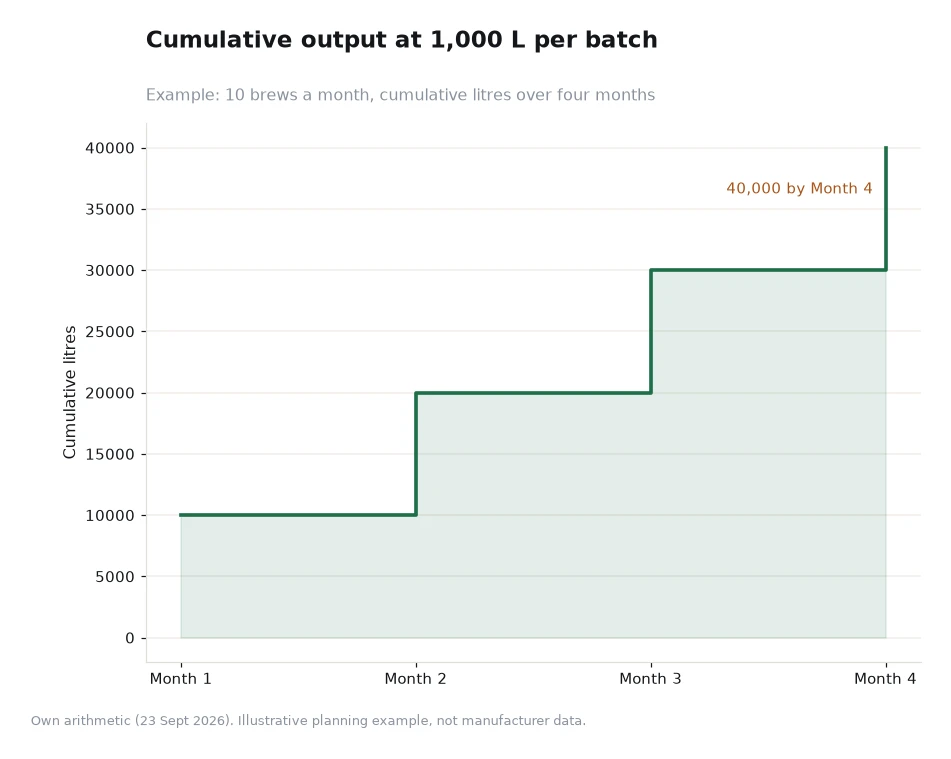
Assume a 1,000 L brewhouse, 10 brews a month, losses ignored, and a four-month horizon. Cumulative output reaches 10,000 L after month 1, 20,000 L after month 2, 30,000 L after month 3 and 40,000 L after month 4, which is about 342 BBL at roughly 117 L per barrel. Sustained over a full year at the same rate, the brewhouse produces 120,000 L, or about 1,026 BBL.
Put that against the published bands and the picture is clear: 1,026 BBL a year sits comfortably inside the micro end of the spectrum, and reaching commercial scale means multiplying the brewhouse, the cellar and the utilities together rather than simply brewing more often. Then add the calendar. Delivery is published at 90 to 150 days from deposit to door, so a deposit paid in March lands the tanks between June and August, and a greenfield site that is still waiting for its electricity connection in June will be storing crates rather than brewing.
Frequently asked questions
What size counts as a commercial brewery project?
The published bands put nano equipment at 5 BBL or less, micro craft systems at 1,000 L to 3,000 L, large commercial equipment up to 100 HL, and hot products in the 20 T to 50 T range, with 5 BBL to 20 BBL systems alongside them. A greenfield plan is easier to build if it sits inside one band.
How long before a new site can sell beer?
Start with the published 90 to 150 days from deposit to door delivery, then add installation, commissioning and operator training. Site works should run in parallel rather than afterwards, because a completed tank room with no electricity connection is an expensive storage area rather than a brewery.
Getting the design service involved early
The most useful step for a greenfield project is to hand the building information to the factory before the equipment is chosen, which is what the free 2D, 2.5D and 3D design service is for. Layout, vessel placement and piping routes come back as drawings you can give to an architect, an electrician and a groundworks contractor, in a form they can price. The brewery system pages set out how the main packages are grouped, and the beer brewing equipment pages list the individual vessels and machines.
If the site is large but the demand is not yet, the micro craft brewery pages show what a smaller first phase looks like inside a building designed for more. Either way, the sequence is the same: fix the site facts, choose the band, and let the drawings carry the project from there.
Capacity bands, hot product sizes, the design service and the 90 to 150 day delivery window quoted here come from the manufacturer's own website, read 23 Sept 2026; the output, barrel and calendar figures are our own labelled arithmetic. [1]