Panel Grades for Bridges, Tunnels and Slabs
Formwork panels are chosen twice: once for the pressure behind them and once for the finish in front of them. For panels pressed with a phenolic film at 165 g/㎡, published reuse guidance runs to 10–20 pouring cycles, while the 18 mm format carries heavy formwork and 21 mm and above is reserved for bridges and high-load platforms. The grade you pick should follow the pour, not the other way round.
Key takeaways
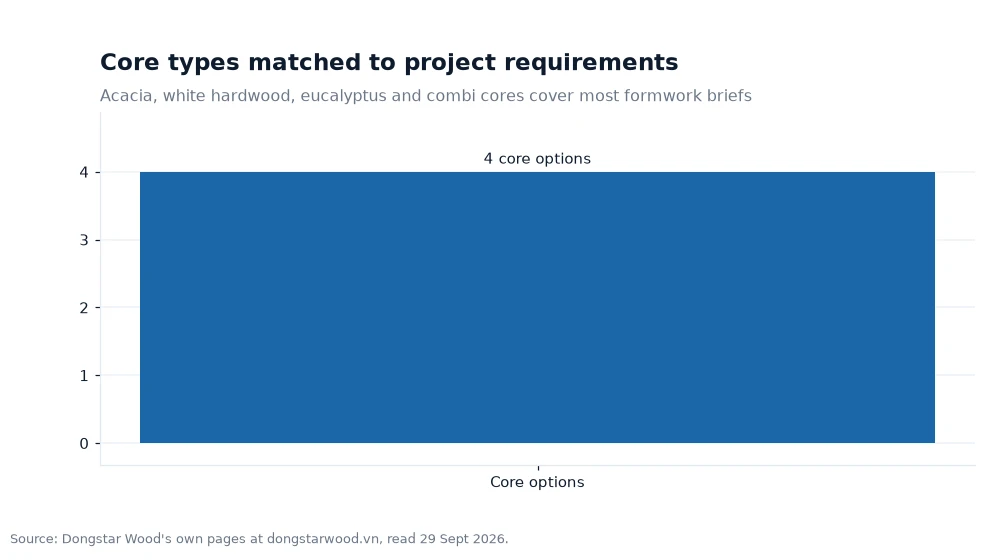
- Four cores cover most concrete briefs — Acacia Core, Eucalyptus Core, White Hardwood Core (Bodhi) and Combi Core.
- Thickness carries the load: 18 mm for heavy formwork, 21 mm and above for bridge decks and high-load platforms.
- Film weight is specified as 165 g/㎡ for a smooth surface and 130 g/㎡ where a lighter face is acceptable.
- With a phenolic film and sealed edges, published reuse guidance reaches 10–20 cycles in concrete pouring.
What changes between a slab, a tunnel and a bridge deck
A repeated slab pour rewards a panel that releases cleanly and goes back on the stack. A tunnel lining adds curvature, confined access and a finish that is inspected in artificial light. A bridge deck adds load and spans the same panel across bearers at wider centres. All three are served by formwork plywood, but they are not served by the same thickness, core or film.
The useful discipline is to write those three variables down before the quotation goes out: pressure at the form face, reuse expectation, and finish class. Everything else — core species, film weight, edge treatment — follows from that list.
Four cores, and the brief each one answers
| Core | Described strength | Where it fits |
|---|---|---|
| Acacia Core | High-strength hardwood, good density, load-bearing capacity | Repetitive pours where the panel must survive many strikes |
| Eucalyptus Core | Compression resistance and bending performance | High-pressure walls and columns |
| White Hardwood Core (Bodhi) | Stability with balanced mechanical strength | Cost-conscious projects with a fair-face standard |
| Combi Core | Eucalyptus and acacia, or hardwood and softwood hybrid | Panels where weight, strength and cost must be traded off |
Core choice also decides how a panel behaves when it is struck. A denser hardwood core holds its edge, which matters more than headline strength once you are six pours into a programme and the corners are taking hammer blows.
Thickness and film weight decisions
Thickness is the simplest lever and the one buyers most often under-specify. Published guidance puts 18 mm on heavy formwork and treats it as the best overall balance for general work, then moves to 21 mm and above for bridges and high-load platforms. The step up is not decoration: it comes from stiffness under pour pressure and from how the panel spans between bearers.
Film weight works differently. A 165 g/㎡ film gives a smoother surface and supports a better fair-face result, while a 130 g/㎡ film is the lighter option where appearance is secondary. Dark brown, black and anti-slip films are all available, and the panel can be built in sizes from 1220 × 2440 mm up to 1500 × 3000 mm or a custom maximum of 1830 × 3830 mm.
Worked example: contact area across a reuse cycle
Take the 1250 × 2500 mm format first, which covers 3.125 m² (1.25 m × 2.5 m) a sheet. At ten pours that works out at 10 × 3.125 m² = 31.25 m² of concrete contact from a single panel, and at the published upper guidance of 20 cycles it reaches 20 × 3.125 m² = 62.5 m². Those are example figures for planning, not a promise for any particular site.
Scale it to the wider sheet: 1500 × 3000 mm measures 1.5 m × 3.0 m = 4.5 m². A 200 m² wall programme therefore needs 200 ÷ 4.5 = 44.4, so 45 sheets on a single-use assumption — but if each panel survives eight pours, the same wall takes 45 ÷ 8 = 5.6, so six sheets plus a spare for damage. That is the difference between buying panels and buying contact area.
Edges, sealing and the second life of a panel
Most panels fail at the edge before the face wears out. Water reaches the core through an unsealed cut, the plies swell, and the panel that should have run ten pours delaminates at the corner. Sealing cut edges and repairing the film between strikes is what turns reuse guidance from a paper number into a site outcome.
The Film Faced Plywood category sets out the films, cores and adhesives in one place, and the adhesive list is worth studying before the first pour: E0, E1, E2, MR, WBP and Phenolic Dynea are offered, and the bond is what holds a panel together after the film has been scarred.
Specifying for curved and confined work
Tunnels and curved walls put pressure on the panel in two directions. The sheet has to bend to the radius without cracking the film, and it has to release from an inclined surface where striking is awkward. A Combi Core panel bent over a controlled radius often outperforms a denser panel that resists the curve, because the compromise that hurts stiffness helps here.
For a genuinely load-heavy deck, the answer is thickness and bearer spacing rather than a thicker film. Take the 21 mm option, tighten the bearer centres, and treat the anti-slip films separately — they belong on walkboards, access platforms and inclined surfaces where crews are standing on the formwork, not on the form face itself.
Where a panel grade goes wrong
Two mistakes account for most disappointing results. The first is buying a thin panel for a heavy pour and compensating with extra bearers, which usually costs more in labour than the thickness would have cost in material. The second is treating film weight as a quality label rather than a surface specification: a heavy film on a soft core still dents.
Both are avoidable with one paragraph in the purchase order, stating thickness, core, film weight, size and bond. That paragraph is also what a mill needs in order to schedule the right batch, rather than substituting whatever is on the press that week.
Frequently asked questions
How many pours can a formwork panel realistically deliver?
Published guidance for high-grade panels reaches 10–20 reuse cycles in concrete pouring. The outcome depends on core density, bond quality, film weight and, above all, how well cut edges are sealed and cleaned between strikes. Economical panels built on a melamine bond are quoted far lower, at roughly 3–5 cycles.
Which thickness should be used for a bridge deck or high-load platform?
The published recommendation is 21 mm and above for bridges and high-load platforms, with 18 mm as the general heavy-formwork choice. Confirm against the pour pressure and the bearer spacing your engineer has calculated, since the panel spans between supports rather than resting on continuous ground.
Is a heavier film always the better specification?
No. A 165 g/㎡ film supports a smoother finish on a fair-faced wall, while a 130 g/㎡ film suits work where appearance is secondary and cost per square metre matters. Match the film to the finish class, and put the money into core and thickness where the load is real.
Where to check the details
Compare the published specification against the pour drawing before the order is placed: sizes, thicknesses, film weights and the six adhesive classes are all listed on the film faced category page. Where crews will be walking on the formwork rather than pouring against it, the anti-slip formwork panels use a textured face for grip instead of a smooth one. For short-cycle site work where a cheaper panel is being written off after a few pours, the economical black film option is the lower-cost route.
Every figure cited in this piece — sizes, thicknesses, film weights and bonds — is drawn from that the supplier's website, checked on 29 September 2026 and taken for this article and taken for this article as the basis for this guide[1].