Custody and Insurance for Hosted Mining Hardware
Hosting splits one asset into two: the miner keeps the coin, the site holds the machine. At 5 PH/s on 20 J/TH hardware, that machine set produces $189.97 of gross mining income a day, $182.37 after the listed 4% fee, against $144.00 of electricity — a contribution of $38.37 a day, or about $14,000 a year that depends on hardware physically sitting in somebody else's building.
Key takeaways
- Custody, not ownership, decides who has to prove a loss happened — so the serial number list and per-worker hashrate history are the insurance policy in practice.
- Efficiency sets the exposure: at 20 J/TH the contribution is about $38 a day per 5 PH/s, while at 30 J/TH the same hardware consumes $64.80 a day against $54.70 of net income on 1.5 PH/s.
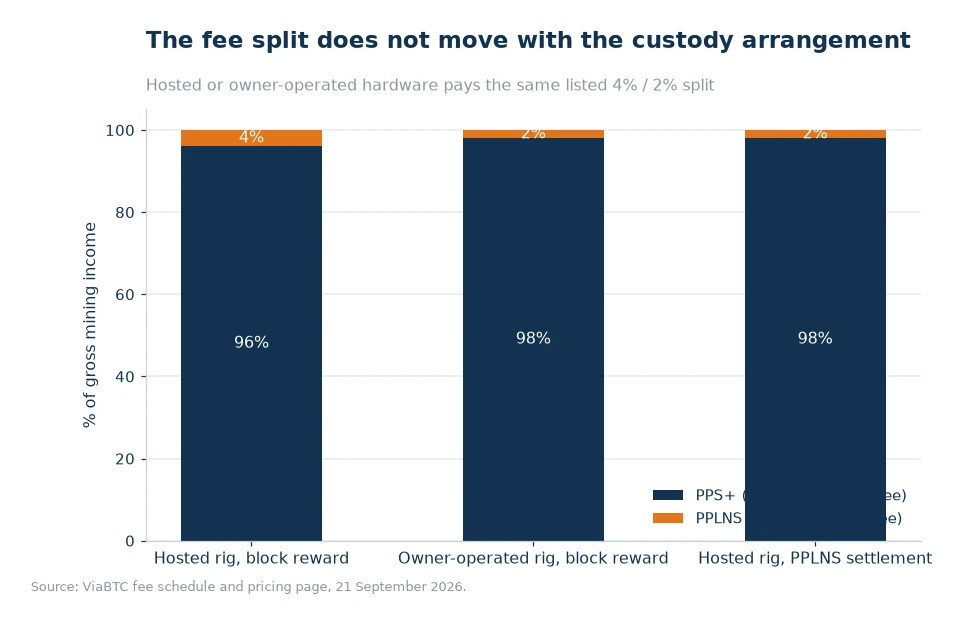
- The listed pool fee structure is 4% on the PPS-settled block-reward component and 2% on the PPLNS-distributed components, and it does not change because the hardware is hosted somewhere else.
- Reconcile the asset register monthly: serial against worker name against expected hashrate, or a swapped unit can stay invisible for a whole contract term.
Why the numbers move
Custody is a chain of transitions. Machines leave a supplier, cross a border or two, sit on a pallet, get installed in a rack, and eventually get decommissioned. Each handover is a point where risk moves from one party to another, and each handover is only as good as the paperwork attached to it. The mining income does not care who owns the machine — it cares whether the machine is powered and submitting shares.
What changes with custody is the informational asymmetry. When your rigs are in your own building, "is that unit running?" is a walk. When they are at a hosting site, the answer arrives as a per-worker hashrate line in a pool dashboard or not at all. The pool's own data is therefore the most reliable independent signal you have about hardware you cannot see, because the pool does not know or care who holds the asset register.
What changes your payout
Almost nothing about a payout changes because hardware is hosted, and that is worth stating precisely, because hosting invoices are often read alongside pool fees as if they were the same kind of cost. Pool fees are a percentage of settled income. Hosting is a cost of operation. They behave differently in a bad month: pool fees fall when income falls, hosting fees usually do not.
| Cost or event | Applies to | Behaviour in a weak month | Who controls it |
|---|---|---|---|
| Listed pool fee, 4% on the PPS-settled block reward | Gross mining income | Falls with income | Payment mode choice |
| Listed fee, 2% on the transaction-fee component | Fee-derived income | Falls with on-chain activity | Payment mode choice |
| Hosting power charge | kWh consumed | Broadly flat, falls only when rigs stop | Site contract and hardware efficiency |
| Insurance premium or deductible | Insured value or claim | Flat, and paid whether or not anything happens | Policy terms |
| Custody loss or damage | Replacement cost | Rare, and unfunded if undocumented | Site operations and your records |
The second column is where hosted miners get surprised. A 4% listed fee on the block-reward component scales down automatically when difficulty rises and income per unit falls. A power charge per kWh does not scale down at all — it scales with how much of the machine's rated draw you are using, which is a hardware property.
Worked example: 5 PH/s, one pallet, two outcomes
Twenty machines at 250 TH/s make 5 PH/s. At 20 J/TH they draw 100 kW, which is 2,400 kWh a day — $144.00 at $0.06/kWh. Gross income is 0.00224 BTC a day, $189.97, and after the listed 4% fee on the block-reward component about $182.37. Contribution is $38.37 a day, or roughly $14,000 a year. That is the number an insurance policy or a custody clause is actually protecting.
Now suppose the pallet arrives and two units are missing from the count. At the same efficiency those two units would have contributed about $3.84 a day, so the direct loss is small in the first month and grows every month after. Where it becomes expensive is in the claim: without a serial list matched to worker names, the site can argue the count was short at delivery, and the miner has no independent record to point at. The remedy is not a better locksmith; it is a spreadsheet paired with pool data.
The same arithmetic applies in reverse when hardware is inefficient. A cluster of six units at 250 TH/s on 30 J/TH is 1.5 PH/s drawing 45 kW — 1,080 kWh a day, or $64.80 — against $56.99 of gross and $54.71 of net income. Insurance and a strict custody clause cannot rescue a machine whose contribution is already negative; the asset that needed protecting was a different purchase decision.
What to check monthly
- Serial against worker. Every machine in the asset register should map to a named worker. A missing mapping is a machine you cannot claim for.
- Hashrate fingerprint. Record each unit's normal operating hashrate when it is healthy. A unit that quietly runs 8% below its fingerprint is a repair case, and a unit swapped for a slower model shows up as a step change.
- Firmware and configuration drift. Firmware changes are usually benign and occasionally not — capture the version per unit once a month.
- Spare parts on site. Fans, power supplies and control boards in stock convert a two-week lead time into a two-hour repair.
- Policy definitions. Check what "loss" means in the policy you actually bought, and whether inbound transit is covered or excluded.
- Contribution per unit. Rank machines by contribution, not by model name. A pool dashboard that shows per-worker hashrate beside current difficulty gives you that ranking from data you already collect.
When hosted hardware is pointed at the same account as your own machines, the audit stops being a negotiation. Hosting through a farm entry point such as ViaBTC Mining Farms keeps the rigs visible as workers in the pool account, so per-unit hashrate history is available to the miner independently of whatever the site reports — the closest thing to a custody audit that runs continuously.
It also keeps the fleet portable. If a coin's economics turn and the operator wants to re-point hardware at another chain, multi-coin mining pools make that a configuration change rather than a move: BTC, BCH, LTC/DOGE merged mining, KAS and other chains remain available against the same account while the hardware stays in place.[1]
Frequently asked questions
Does the payout method change my average income?
It changes the variance and the fee, not the underlying expected value: your share of network hashrate still sets the ceiling.
How often should a miner check pool statistics?
Weekly is enough for cash flow, daily if you are reconciling worker uptime or chasing a hashrate fault.
Does hosting change the pool fee I pay?
No. The listed fee follows the payment mode — 4% on the PPS-settled block-reward component, 2% on the PPLNS-distributed components — not the location of the hardware.
What documentation should travel with the hardware?
A serial list, a photo of each unit's label, the agreed baseline hashrate and the handover signature for every custody transition. Without those, a shortage discovered months later is very hard to attribute.
Build the register before the next shipment
Write the serial list now, in the same file as the worker names, and photograph each unit's label before it leaves your hands. Set a monthly reminder to compare those records against per-worker hashrate, and keep the two numbers next to each other so a slow machine and a missing machine are distinguishable at a glance. Documentation is the cheapest insurance a hosted miner will ever buy — it costs an afternoon and it decides whether a claim is paid.
Data and sources: ViaBTC fee and hosting documentation[1]. Network difficulty (132.76 T), network hashrate (1,003 EH/s) and the BTC price of $84,692 come from public chain data and market feeds read on 21 September 2026; all income, power and contribution figures are own calculations from those inputs. Hosting prices and insurance terms vary by operator and are not quoted here.